
The Node Ahead 120: The Next Crypto Cycle Is Already Being Built
Issue 12

Bull markets technically begin when prices start rising. But the foundations that make those rallies possible are usually laid years earlier, during the preceding bear market, when developers quietly build new infrastructure that reaches meaningful adoption long before the broader market notices. Once those new capabilities begin generating real economic activity, adoption accelerates, excitement builds around the new use case, and prices eventually follow.
Today, crypto prices remain well below their previous highs, and much of the industry has once again been written off. To most observers, it feels like another quiet period between market cycles.
Beneath the surface, however, a different story is unfolding. Developers continue building. Users continue adopting new products. Some of the world’s largest financial institutions are no longer just studying blockchain technology—they’re building products and services on top of it. New infrastructure is quietly reaching meaningful scale, even though much of that progress has gone unnoticed by the broader market.
This pattern has repeated throughout crypto’s history. Every major cycle has been preceded by a period when new infrastructure quietly matured while prices remained depressed. That infrastructure didn’t cause the next bull market by itself, but it created the conditions that made the next wave of growth possible.
Looking back, the biggest breakthroughs weren’t simply successful applications. They were pieces of infrastructure that expanded the range of economic activity blockchain networks could support. Bitcoin made digital money possible without a central intermediary. Ethereum made decentralized software possible. Stablecoins created an internet-native dollar economy. DeFi built on-chain capital markets. Hyperliquid extended those markets into derivatives. Each expansion made crypto capable of supporting a larger economy than before.
Markets rarely recognize those shifts in real time. New infrastructure is difficult to value before its potential is visible in adoption and economic activity. The engineering comes first. Usage grows gradually. New uses and economic activity emerge. Only later does the broader market recognize what has changed.
That’s why I spend less time focusing on short-term price movements and more time looking for infrastructure that is quietly becoming indispensable. History suggests that by the time a new technological foundation becomes obvious, much of the underlying progress has already happened.
Today, two areas stand out above everything else. Tokenization has the potential to bring the world’s financial assets on-chain. The convergence of AI and crypto has the potential to bring an entirely new class of autonomous economic participants into the network.
At first glance, they appear to be separate stories. I think they’re actually part of the same expansion.
Every Cycle Expanded Crypto’s Economy
Looking back, every major crypto cycle followed a remarkably similar pattern. The breakthroughs that shaped each cycle expanded the economy that could exist on blockchain networks, enabling entirely new forms of economic activity that weren’t possible before.
Bitcoin introduced digital money that could be transferred without a central intermediary. Ethereum expanded that foundation by making blockchains programmable, allowing developers to build decentralized applications that simply couldn’t exist before. What began as a network for moving value became a platform for building software, laying the foundation for an entirely new on-chain economy.
Stablecoins marked the next major expansion. Before they existed, blockchain networks were used primarily to transfer crypto-native assets like BTC and ETH. Stablecoins brought dollars on-chain, transforming blockchains into global payment networks capable of moving the world’s most widely used currency. That seemingly simple innovation unlocked an internet-native dollar economy that continues to grow today.
The next expansion came through decentralized finance, or DeFi. Protocols such as Uniswap and Aave weren’t just successful applications. They became foundational financial infrastructure that other developers could build on. Permissionless exchanges, lending markets, and other financial services could now exist natively on blockchain networks, creating an open capital market that operated without traditional financial intermediaries.
More recently, Hyperliquid demonstrated that decentralized infrastructure could compete in one of finance’s most demanding markets: perpetual futures trading. It showed that sophisticated derivatives markets could operate directly on blockchain infrastructure rather than centralized exchanges, expanding crypto into another major segment of global finance.
Each of these breakthroughs made blockchain networks capable of supporting a larger economy than before. Just as importantly, all of these key pieces of infrastructure were built during bear markets.
Ethereum and USDT were both developed during the depths of the 2014-2015 bear market and gained meaningful adoption long before the next cycle began. Uniswap and Aave were built while sentiment remained deeply negative after the 2018 crash. Hyperliquid launched shortly after the 2022 market bottom and became one of crypto’s fastest-growing applications well before its token attracted widespread attention.
At the time, none of these projects looked like the foundation for the next cycle. They looked like small teams solving niche problems for a relatively small group of early adopters. Only in hindsight did it become clear that they were building infrastructure that enabled entirely new forms of economic activity.
The pattern has repeated often enough that I think it’s worth paying attention to today.
Bitcoin, stablecoins, and decentralized finance will likely continue growing for years to come, but those expansions are already well underway. The more interesting opportunity is identifying the infrastructure that is quietly enabling the next expansion of crypto’s economy while most of the market is still focused elsewhere.
Today, I believe two areas stand out.
The Next Asset Expansion: Tokenization
For years, tokenizing real-world assets was largely viewed as an interesting experiment. Conferences were filled with discussions about putting real estate, fine art, and collectibles on blockchains. The idea generated plenty of excitement, but very little meaningful adoption. That has started to change.
Today, tokenization is increasingly focused on assets where blockchain infrastructure provides clear economic advantages. U.S. Treasury securities, money market funds, private credit, commodities such as gold, and public equities are moving on-chain because they can settle faster, trade around the clock, move globally with fewer intermediaries, and integrate directly with on-chain financial applications. The assets themselves aren’t changing. The infrastructure around them is.
That distinction is important. Ethereum didn’t become valuable because smart contracts were an interesting technology. It became valuable because developers used them to build entirely new software businesses. In much the same way, tokenization isn’t simply about representing existing assets as digital tokens. It’s about making those assets programmable, interoperable, and native to blockchain networks, allowing developers to build financial applications that weren’t previously possible.
The adoption data suggests this transition is already underway. According to RWA.xyz, the market for tokenized real-world assets, excluding stablecoins, has grown from less than $3 billion in mid-2024 to more than $38 billion today—an increase of more than tenfold in under two years.
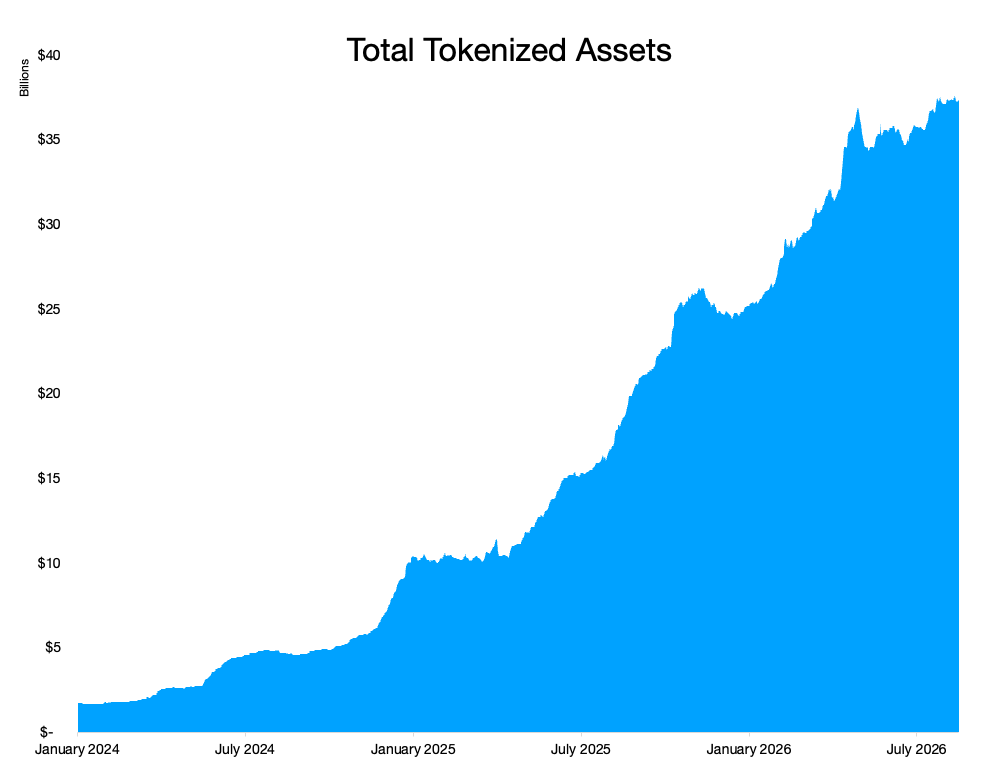
What’s particularly striking is when that growth occurred.
It didn’t happen during a euphoric bull market driven by speculation. It happened while much of the broader crypto market remained well below its previous highs. Since bitcoin peaked last October, tokenized real-world assets increased by 50% even as many crypto assets have fallen sharply. Once again, infrastructure adoption has continued even while market sentiment remained subdued.
The composition of that growth is just as important.
A year ago, tokenized crypto-linked products represented most of the market. Today, much of the growth is coming from traditional financial assets. Treasury securities, money market funds, private credit, commodities, and public equities are becoming some of the fastest-growing segments. Crypto spent the past fifteen years building financial infrastructure around digital assets. Now traditional finance is beginning to use those same rails.
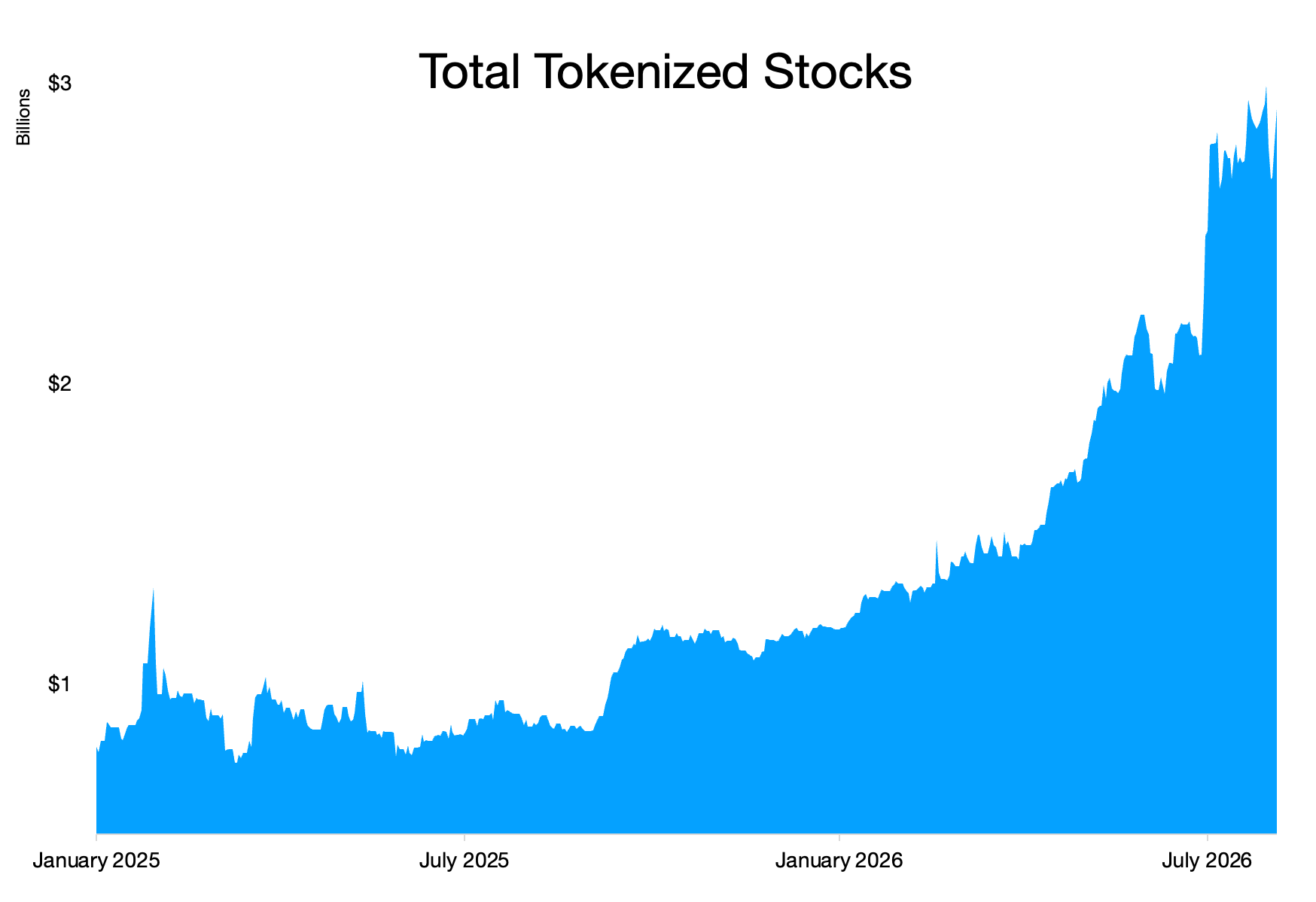
The momentum is especially visible in tokenized equities and private credit. Tokenized stocks have grown more than fivefold over the past year, while monthly transfer volume has increased from tens of millions of dollars to more than $9 billion. On Solana alone, tokenized equity trading volume has grown from roughly $1 million to more than $3 billion over the same period. Asset-backed credit reached a $1 billion market capitalization just 185 days after its first recorded on-chain activity, making it the fastest-growing category of tokenized assets to date.
Just as telling is who is building. Previous crypto cycles were driven primarily by crypto-native startups. This time, many of the largest developments are coming from established financial institutions. BlackRock launched BUIDL. Franklin Templeton expanded its on-chain money market fund. Apollo, Hamilton Lane, and WisdomTree continue bringing investment products on-chain. Robinhood has announced plans for tokenized equities. DTCC recently processed its first live production trades of tokenized Treasuries and equities, while the parent company of the New York Stock Exchange is building an on-chain trading venue for tokenized securities.
Wall Street is no longer treating blockchain as something to study. It’s increasingly treating it as infrastructure to build on.
Despite that progress, tokenization remains tiny relative to the markets it could eventually serve. Global bond markets exceed $140 trillion, public equities are worth well over $100 trillion, and money market funds, private credit, and commodities represent tens of trillions of dollars more. Only a tiny fraction of those assets exist on-chain today. That gap is what makes this expansion so compelling.
Previous crypto cycles mostly built entirely new markets around crypto-native assets. Tokenization is different. It brings some of the world’s largest and most established financial markets onto infrastructure that crypto has spent more than a decade building.
In every previous cycle, blockchain networks expanded by supporting new forms of economic activity that didn’t exist before. Tokenization represents the next step in that evolution. It extends blockchain infrastructure beyond the crypto economy and into global capital markets, dramatically increasing the range of assets that can participate in the on-chain economy.
The Next Participant Expansion: AI
If tokenization expands the assets that can exist on blockchain networks, artificial intelligence has the potential to expand the number of participants.
For most of the internet’s history, every economic transaction ultimately began with a person. Humans opened bank accounts, entered payment information, approved purchases, and signed contracts. Software helped automate those processes, but it wasn’t an independent participant in the economy. That assumption is beginning to change.
The latest generation of AI agents can already search the web, write software, analyze information, and complete increasingly complex tasks with minimal human involvement. As they become more capable, they’ll begin doing something even more important: buying services, hiring other AI agents, paying for data, renting computing power, and completing transactions on their own.
Traditional financial infrastructure wasn’t designed for that world. An AI agent can’t open a bank account, complete identity verification, manage passwords, or type a credit card number into a checkout page every time it needs access to a service. The financial system we use today assumes a human is involved in every transaction. Autonomous software requires a different kind of economic infrastructure.
Blockchain networks already provide many of those capabilities. A wallet can hold digital assets. Stablecoins allow instant global payments. Smart contracts make agreements programmable. Cryptographic keys provide identity and authorization. Together, they allow software to own assets, exchange value, and coordinate directly with other software without relying on a person to approve every step.
That infrastructure is no longer theoretical. Coinbase’s AgentKit gives AI agents blockchain wallets and programmable permissions. The x402 protocol revives the long-unused HTTP “402 Payment Required” standard, allowing an AI agent to purchase an API or digital service automatically as part of a single request. Stripe, Cloudflare, Amazon Web Services, and Google have all integrated or published infrastructure supporting this emerging model of machine-to-machine commerce.
According to publicly available on-chain data, x402 has processed more than 160 million cumulative machine-to-machine payment transactions since its launch just over a year ago, while new payment standards such as Stripe’s Machine Payments Protocol are rapidly expanding the ecosystem for autonomous commerce. Most of these payments are tiny—often fractions of a cent—but that’s precisely the point. They represent software paying software, automatically, at a scale and frequency that traditional payment systems were never designed to support.
The transaction volumes remain small relative to the global economy, much like tokenized assets remain tiny relative to global capital markets. But the pattern looks familiar.
Ethereum didn’t launch with thousands of applications. Stablecoins didn’t immediately become a global payment network. DeFi didn’t begin with billions of dollars in lending markets. Each started as infrastructure serving a relatively small group of early adopters before gradually becoming indispensable as adoption accelerated. AI appears to be following the same path.
The significance isn’t that AI will replace people. It’s that software is beginning to participate in the economy as an independent actor rather than simply a tool. That changes the size of crypto’s addressable market.
Historically, financial infrastructure has been built for roughly eight billion people, along with the businesses and governments they create. AI agents are fundamentally different. A single person or company could eventually deploy dozens, hundreds, or even thousands of specialized agents, each capable of earning, spending, negotiating, and coordinating on its own behalf. As the cost of creating these agents continues to fall, the number of economic participants could eventually grow far beyond the human population.
Previous crypto cycles expanded the kinds of economic activity that could happen on-chain. AI expands the number of participants capable of taking part.
For the first time, blockchain networks are being built not only for people, but also for autonomous software. If tokenization extends crypto into the world’s financial assets, AI has the potential to extend it into an entirely new machine economy.
The Biggest Expansion Yet
At first glance, tokenization and the convergence of AI and crypto appear to be unrelated trends. I think they’re actually part of the same expansion.
Every major crypto cycle has increased the amount of economic activity blockchain networks could coordinate. Bitcoin introduced non-sovereign digital money. Ethereum enabled decentralized software. Stablecoins brought dollars on-chain. DeFi created open, non-custodial capital markets. Hyperliquid extended those markets into derivatives. Each breakthrough expanded crypto’s addressable market by making blockchain networks useful for a larger economy than before.
Today’s expansion is happening along two dimensions at the same time.
Tokenization expands what blockchain networks can coordinate. Instead of supporting only crypto-native assets, they can increasingly support stocks, bonds, money market funds, private credit, commodities, and eventually much of the world’s financial system.
AI expands who blockchain networks can coordinate. Instead of serving only people and businesses, they can increasingly support autonomous software capable of owning assets, making payments, and participating directly in economic activity.
One expansion brings trillions of dollars of traditional financial assets on-chain. The other could eventually bring billions—and perhaps one day trillions—of autonomous economic participants.
Together, they represent the broadest expansion yet of crypto’s addressable market.
That doesn’t mean either trend is guaranteed to succeed. Many promising technologies never achieve widespread adoption, and the next major crypto cycle could ultimately be driven by something entirely different.
But history suggests that the biggest shifts in crypto rarely begin with prices. They begin with infrastructure.
During every previous bear market, developers quietly built technologies that expanded what blockchain networks were capable of coordinating. Adoption followed. New economic activity emerged. Only later did the broader market recognize what had changed. The same pattern appears to be unfolding today.
Whether tokenization and AI ultimately become the defining themes of the next cycle will only be clear in hindsight. But the early signs are already visible. Real products are being built. Usage is growing. Institutions are committing resources. Entirely new forms of economic activity are beginning to emerge.
Bull markets don’t create those foundations. They reveal them.
Disclaimer: This is not investment advice. The content is for informational purposes only, you should not construe any such information or other material as legal, tax, investment, financial, or other advice. Nothing contained constitutes a solicitation, recommendation, endorsement, or offer to buy or sell any securities or other financial instruments in this or in any other jurisdiction in which such solicitation or offer would be unlawful under the securities laws of such jurisdiction. All Content is information of a general nature and does not address the circumstances of any particular individual or entity. Opinions expressed are solely my own.